Ecological overshoot, or “overshoot” for those of us counting our syllables, is when human demand exceeds the planet’s capacity to sustainably regenerate its resources. It also happens to be the primary driver of large-scale animal suffering today. While animal rights and veganism focus on direct and intentional exploitation, most harm caused to non-human animals occurs unintentionally as collateral damage of humanity’s ever-expanding footprint. My argument is that habitat loss, climate change, pollution, and ecosystem collapse currently dwarf the harms of targeted animal exploitation. While the evidence is extensive, much remains excluded from mainstream consensus due to its incompatibility with past studies predicated on flawed methodologies and with the agendas of numerous influential entities of the religious, governmental, and corporate varieties. The implications are uncomfortable, and significant parts of the conversation remain uniquely taboo. What my argument is NOT is that veganism and animal rights are any less important than ever. Our current form of animal agriculture is uniquely indefensible because it is a high-impact, high-suffering, low-necessity practice that accelerates every overshoot driver simultaneously. Brace yourself for a long one! This is going to need some context.
Direct Exploitation vs. Collateral Ecological Harm
Animal rights and veganism are important to me for all the obvious reasons – they aim to address several issues of moral urgency such as large-scale and high intensity suffering, exploitation, speciesism, environmental damage, and more. I’m a big fan of non-human creatures for both their intrinsic and instrumental value in contributing to the resilience of ecosystems on which pretty much everything we care about relies. In many ways, veganism addresses a root cause of animal suffering, namely human-perpetrated exploitation and mistreatment driven by the material and economic benefits we can extract. While addressing these injustices will always be important, animal exploitation doesn’t cover the majority of harms caused by humanity, which occur not as an intentional result of targeted industrial activity but as unacknowledged, unquantified, and unintended concequences of human expansion.
Let’s elaborate on this distinction. Animal product markets result in harms that are targeted, chronic, intentional, systematic, and highly controlled. These impact an enormous number of individuals (80+ billion land animals and 1-2 trillion marine animals slaughtered annually) but only a limited number of species, few of which are under threat (exceptions include bushmeat species and sizable targets of poaching, whaling, and overfishing). In contrast, the inadvertent harms caused by humanity’s ever-expanding footprint are largely unintentional and uncontrolled but impact millions of species and an unquantifiable number of individuals. These harms occur through habitat loss, climate change, pollution, and cascading ecosystem collapse resulting in starvation, displacement, reproductive failure, disease, predator-prey imbalances, heat stress, and more. Not only are individuals suffering, but entire lineages are being erased as we enter into (re: perpetuate) the Holocene extinction, our world’s 6th and fastest mass extinction event.
How Population Became an Impossible Conversation
At this point, I imagine some folks might be wondering: is this going to get racist, eugenics-y, sexist, or..? The answer is no, but I want to talk about why this is a predictable question, and it involves a bit of history.
In 1798, Thomas Malthus published An Essay on the Principle of Population, launching a tradition of problematic Malthusian and neo-Malthusian demographic theory that persisted and developed through the 20th century. The legacy of this work might have been largely positive had he merely described the inevitable consequences of exponential human growth outpacing the planet’s capacity to regenerate resources at a sustainable rate (aka overshoot). Unfortunately, he described not only demographic limitations but detailed a variety of “preventative checks” that were inherently discriminatory and frequently enacted with coercion and violence. These prescriptions included forced sterilization, restrictions on marriage and reproduction, and policies targeted at poor, disabled, Indigenous, and racialized individuals and communities, thereby ossifying in culture a durable association between population concerns and eugenics. From North America (where I live) and many other parts of the world, numerous concrete examples can be drawn, the most salient in public memory being the forced or coerced sterilizations of Black and Indigenous women perpetrated through the 20th century and persisting as documented human rights violations into the present decade.
These abuses were not the single origin of the present-day population taboo. During a series of UN human rights conferences throughout the 1990s in which feminist movements fought to establish women’s sexual and reproductive autonomy, transnational conservative alliances (TCAs) largely comprising religious fundamentalist actors coalesced and mobilized to obstruct feminist efforts. These alliances strategically promoted natalism through patriarchal family models while simultaneously suppressing international discourse on the ecological and social implications of population growth. In an understandable but misguided effort to defend reproductive rights against TCA incursions, the International Population & Development community adopted an approach that largely involved silence on matters pertaining to population out of fear that addressing problems involving population size, fertility rates, or demographic limits might risk being interpreted as support for coercive population control or patriarchal interference in women’s bodies. By treating this discourse itself as dangerous, the International Population & Development community inadvertently carried water for the TCAs by protecting and legitimizing the natalist premises that frame procreation as both natural and obligatory. Ironically, the taboo around population came (and continues) to serve the same patriarchal structures it sought to resist.
In the Western world, overt pronatalism at the level of policy is less visible than in many countries, but it remains strongly influential in social and political realms. Examples include uneven access to reproductive healthcare, medical gatekeeping around voluntary sterilization, the medicalization of infertility through assisted reproductive technologies, the persistent social construction of womanhood as inseparable from fertility and motherhood, the all-too-common familial pressure of intergenerational expectation to carry on a genetic lineage, and more – these influences interact with a legacy of overt top-down reproductive coercion described above such that population-oriented discussion today often feels precariously close to moral trespass and/or an infringement on individual rights and freedoms. They are easily misread and readily misinterpreted as implied judgments about who should or should not reproduce along axes of race/nationality, sex/gender, and class/economic status.
Matters were further complicated in the public eye by population initiatives in the mid 1900s disproportionately targeting developing nations while ignoring the significantly higher per-capita consumption of wealthy nations, thereby reinforcing the perception that “overpopulation” was a euphemism for “too many brown/poor people”. Population concerns became (and remain) politically radioactive due not only to the overt racist themes promoted in the past, but also their incompatibility with the growth-addicted ideology that permeates mainstream economic theory. Then, as now, population is frequently considered a misdirection to avoid addressing matters of consumption and inequality, narrowing environmental discourse to focus on production and consumption.
In summary, population remains a highly loaded topic whose environmental relevance is overshadowed by concerns about racism, eugenics, colonialism, misogyny, and authoritarianism. As we witness reproductive freedoms being repealed for our Southern neighbours during the current administration (from the erosion of abortion access to persistent medical paternalism), many are inclined to prioritize protection of human rights over ecological stability and animal rights when a conflict between these objectives is erroneously assumed. Ethical population discourse today is possible, but it requires intention and effort to disentangle it from its historical baggage, and a firm grounding in choice, justice, and accountability for high-impact societies like ours (or at least mine – I don’t know who’s reading this, but thank you for doing so). Until these distinctions are adopted by the mainstream, population discourse and the urgency of overshoot will remain obscured by collective historical trauma and fear of repeating past harms.
Is Overpopulation Real? Is Overshoot Actually Happening?
Yes it is, and the evidence is not subtle, but it’s often buried. Major environmental organizations (ie: Sierra Club, Friends of the Earth, WWF affiliates, etc.) avoid mentioning population in campaigns and explicitly instruct staff to avoid the topic, describing it in internal documents as strategically radioactive due to justifiable fears of donor backlash/withdrawal or accusations of eco-fascism. One example that particularly bothers me can be found in the 2022 Intergovernmental Panel on Climate Change report; while the full report and technical summary identify overpopulation as one of the primary drivers of climate change and ecological devastation, population as a causal factor has been removed entirely from the summary for policy makers. For evidence of our impact, the Planetary Boundaries framework attempts to define a safe and sustainable operating range for humanity across nine critical Earth system limits. Unfortunately, we’ve already exceeded seven of them.
1) Carbon dioxide concentration upper boundary: ~350ppm. Current concentration: >420ppm and counting. Result: average global temperatures are rising well past the Holocene range.
2) Biosphere integrity (genetic & functional): species extinction rates are estimated to be at least 100–1,000 times the background rate. This range is consistent with past mass extinctions.
3) Land system change upper boundary: 15-20% of ice-free land converted for agriculture and settlement. Current ice-free land conversion: 30–40%. Result: impaired capacity for the maintenance of a stable climate and ecosystem function.
4) Freshwater systems: use has exceeded planetary limits at local and regional levels. Result: Major river basins and aquifers are being depleted faster than they can refill.
5) Biogeochemical flows: upper boundary for human activity-related nitrogen and phosphorus fixing rate: 62–82 Tg/year and 11Tg/year, respectively. Current nitrogen and phosphorus fixing rate: 190 Tg/year and 22.6 Tg/year, respectively. Result: freshwater and coastal ecosystems are destabilized worldwide (eutrophication and toxification of aquatic systems, ocean acidification, soil degradation, air pollution, etc.).
6) Novel entities: difficult to quantify but decisively crossed. Production and release rates for synthetic chemicals, plastics, and persistent pollutants currently exceed our capacity to assess, monitor, or remediate their impacts.
6) Ocean acidification: The ocean’s surface has dropped by approximately 0.1 pH, which is a 30-40% increase in acidity. Result: ocean’s capacity to act as a buffer/stabilizer diminished, undermining the resilience of marine ecosystems. This boundary was only recently crossed.
7 & 8) Atmospheric aerosol loading & stratospheric ozone depletion. Apparently we’re still in the safe operating ranges for these two, at least for now.
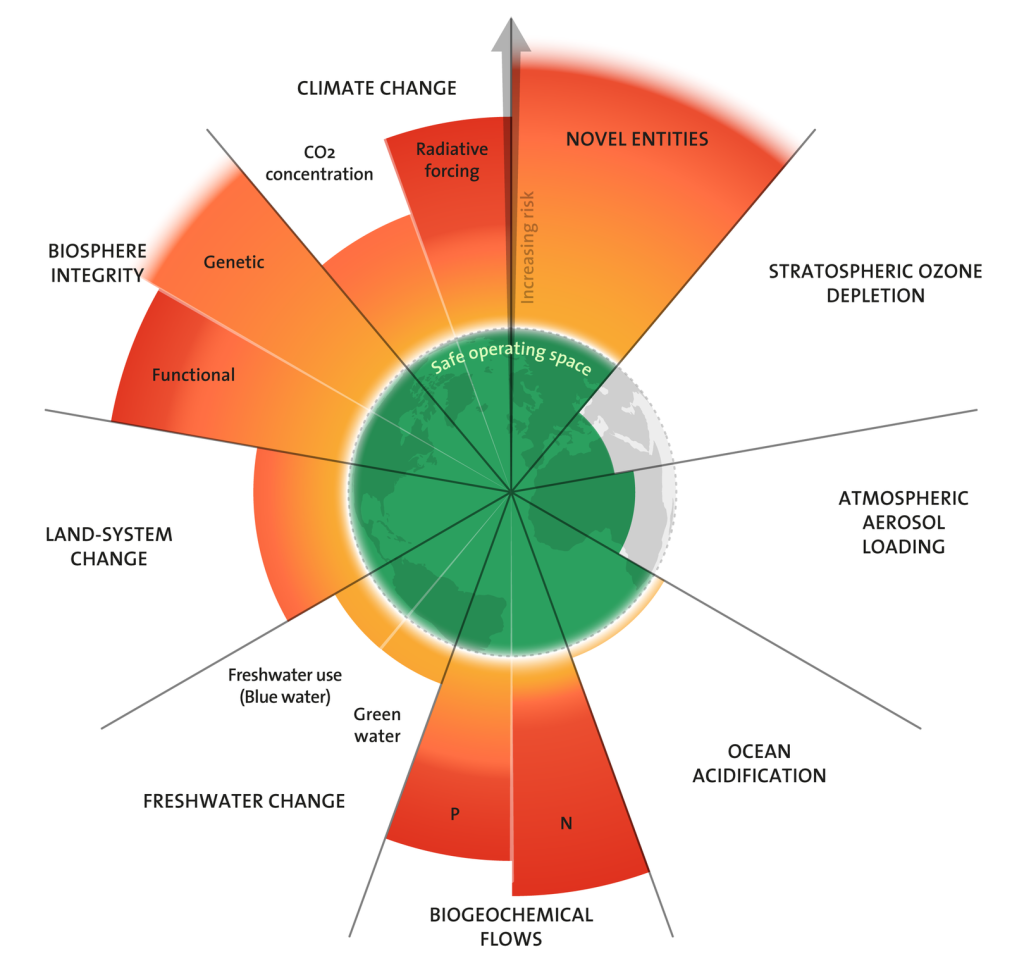
2025 Planetary boundaries. Image credit: Stockholm Resilience Centre
Can’t This Be Addressed by Reducing Consumption?
Not realistically. These arguments tend to champion social and racial equity concerns, which strikes me as an earnest and laudable motivation, but for many reasons, the premises tend to be deeply flawed. They ignore biophysical limits that exist before consumption is discretionary (ie: land conversion for housing and infrastructure, habitat fragmentation, freshwater demand, nitrogen and phosphorus cycling, disease dynamics and zoonotic spillover, etc.). They’re mathematically fragile in their refusal to acknowledge population as an inevitable issue over a certain threshold. In all impact models (IPAT, KAYA, STIRPAT, ImPACT, etc.), population is a multiplicative driver. Even with extremely low per-capita consumption and extremely high efficiency, high enough population levels will push systems past all ecological limits.
To be clear, extremely low per-capita consumption is code for “almost everyone is very poor and things are terrible”. Population impact may be temporarily masked by technology or efficiency, but at best, these factors merely kick the can down the road, and at worst, they enable us to entrench ourselves deeper into overshoot (more on this below). Perhaps most obvious of all, they’re just plain naive. When have we ever witnessed rapid, voluntary, and sustained reductions in material throughput? When has there ever been a widespread political willingness to constrain economic growth or to cooperate globally such that coordinated action across unequal societies is even an option? There is no historical precedent, and previous attempts have largely resulted in political backlash and/or economic contraction. Reductions have been partial, short lived, unevenly distributed, and offset by rebound effects, which are often predictable given the systems and feedback loops that govern social change. Speaking of rebound effects…
Won’t Technology Save Us? The Danger of Techno-Optimism
I argue that faith in a yet undiscovered technological solution is outright dangerous and has contributed substantially to our current mess. Assuming that future innovation will resolve biophysical limits enables us to justify inaction on the difficult political and personal changes necessary to change course (ie: reducing material throughput, stabilizing population (or allowing it to decline, if I may be so bold), and finding alternatives to economic models contingent on growth). Techno-optimism allows present high-impact behaviours to continue unchecked, thereby offloading responsibility for solving the mess we’re continuing to make onto future generations. It transforms urgent collective action problems into a waiting game, which doesn’t account for the cumulative and irreversible nature of ecological damage and the resulting broad-scale suffering.
Furthermore, past technological “solutions” like the Green Revolution didn’t solve ecological limits issues so much as postpone their consequences by enabling further expansion. Higher agricultural yields mitigated incidents of famine in the short term, but they also facilitated rapid population growth, intensified fertilizer, energy, and water use, accelerated soil degradation, and entrenched our dependence on fossil fuels. Many otherwise intelligent individuals consider relying on novel tech to bail us out of this existentially precarious situation to be the sane and healthy approach, labeling skepticism towards tech as irrationally pessimistic. Clearly I don’t see techno-optimism as a reasonable perspective. To me, it’s more akin to raising one’s credit limit and slowly maxing it out while waiting for and counting on the limit to be raised time and time again. The temporary relief and perceived surplus afforded by innovation is immediately allocated to the expanded demand, leaving the underlying debt larger than ever. All the consequences we’re experiencing as a result of exceeding planetary boundaries? That’s just the interest we’re paying. I dread to think of what happens when the lender comes to collect.
What Does an Effective Way Forward Look Like?
At the policy level, the most effective population-related interventions are already well documented and they do not include control or coercion. Empowerment-based strategies such as universal access to contraception and abortion, comprehensive sex education, gender equality, and educational opportunities for women and girls reliably lead to lower fertility rates (and human wellbeing in general). We’ve got plenty of examples. Numerous initiatives throughout the 1970s-90s have successfully reduced birthrates through the provision of these resources and opportunities in several countries including Bangladesh, Iran, Rwanda, Nepal, South Korea, Ethiopia, Mexico, and others, thereby reducing suffering across species by reducing demand for land, water, and other lives, all without coercion, without targeting, and without violence. Admittedly, some countries such as Iran have since faced significant setbacks in women’s rights, but fertility trends continue to decline in others as quality of lives improve.
At the cultural level, pronatalism must be dismantled. The assumption that reproduction is a duty, a marker of success, or the primary path to meaning needs to be excised from our narratives and social incentive structure. A culture that respects reproductive freedom has to celebrate childfree lives, support non-biological forms of care, kinship, and family, stop equating gender identity and human worth with reproduction, and represent all of the above in its narratives, media, marketing, and everyday social cues. These norms matter because they provide the invisible framework for what people consider normal and acceptable.
Most vegans recognize that slavery didn’t end because every person independently reasoned their way to abolition, but because slavery was made socially, legally, and morally unacceptable. However, many people who otherwise oppose animal cruelty continue to support it by consuming animal products because doing so remains culturally normalized. In the same way, when reproduction is treated as the default and people are bombarded by messaging conveying an expectation to procreate from a young age, divergent decisions are considered deviations rather than legitimate life choices. Just as norms can erode meaningful notions of choice, they also have the power to expand and choices, allowing people to make reproductive decisions free from inherited scripts and social pressure.
As per my article on how social change happens, meaningful change requires buy-in at the individual level. Not through guilt or obligation (at least that’s not what I’m proposing), but through decisions informed and supported by an expanded sense of integration with the systems with which we’re in relation. Choosing to have fewer or no children can be understood as a legitimate, compassionate, pro-animal choice; one among many valid life paths, but not a moral requirement. Just as veganism attempts to reframe daily consumption habits in a broader context, voluntary family size decisions can be seen not only as a personal choice, but as an ecological decision as well.
Finally, any serious commitment to animal welfare requires confronting high-consumption societies first. If affluent nations continue to demand endless growth, the damage will expand and accelerate. Reducing fertility rates and per-capita consumption are not competing priorities; they are complementary necessities. Avoiding discussions of the former because of the historical baggage of past abuses cements continued harm in the present, which are borne disproportionately by non-human animals, ecosystems, and future generations. If veganism is about minimizing unnecessary suffering, then expanding our lens beyond direct intentional animal exploitation doesn’t contradict the movement. Instead, it helps it develop into something greater. Yes, the question of whether we care enough to give up the conveniences afforded by animal exploitation is as relevant as ever. But so is the question of whether we care enough to reckon with the consequences of our rapid expansion with intellectual honesty, care, and without repeating the mistakes that brought us to where we are today.